Thursday, April 21, 2016

Don’t Blame a Weaker Military on Money


http://nationalinterest.org/blog/the-skeptics/dont-blame-weaker-military-money-15867


Daniel L. Davis 


In recent weeks, there’s been a steady drumbeat in the media of calls to increase defense spending. In newspapers, TV and radio, this chorus contends that a shrinking military budget is putting U.S. national security at risk. Repeal the Budget Control Act and boost Pentagon spending, they warn, or suffer the consequences of a less secure nation. The time has come to expose the fact these claims are without merit and instead shine a light on the real cause of our dwindling military capabilities.

The American military’s shrinking capabilities have very little to do with money. Rather, they are the result of internal mismanagement. The only way to strengthen our national security is not to spend more money, but rather to reform the way the Department of Defense does business.

It boggles the mind that the DoD cannot account for the hundreds of billions of dollars a year that it spends. A full twenty-six years after a federal law was passed requiring all parts of the federal government to provide Congress with an audit of its spending, there remains only a single government agency that has not complied: the Department of Defense. Even after being publicly rebuked by the Senate in 2013 for this failure—and wasting billions of dollars on failed auditing software—the Pentagon remains noncompliant. Although it’s a major problem that we don’t know how the Pentagon spends its money, an examination of the known expenses is even more alarming.

Look no further than the $500 million spent to train Syrian rebels to fight ISIS. That program was scrapped after putting only a handful of trainees on the ground. Or the $468 million spent on planes for the Afghan Air Force that we were forced to destroy because the Afghans could not fly or maintain them.

Even worse, consider the $20 billion spent by the Army on its Future Combat System, which was supposed to develop the next generation of armored vehicles, but produced exactly zero new pieces of equipment. The weakened state of today’s military has not been caused by insufficient appropriations, but by sometimes breathtaking mismanagement within the Department of Defense.

The time has come to genuinely reform the Pentagon in ways that are commensurate with the caliber of the mismanagement. There are many changes that need to be made but three fundamental changes stand out as being necessary to enable our military to successfully navigate an uncertain global future.

First, is institutional reform. The DoD must become “joint” in more than name alone. That means the mindset and priorities should shift away from the individual services and towards our national military capabilities. Ground forces (Army and Marines), for example, should be integrated closely with air forces (Navy, Marines, and Air Force) in capability and training. Unnecessary and redundant capabilities should be eliminated and single-service headquarters should be scrapped or reduced in favor of fewer and more efficient joint-force headquarters.

Second, the Pentagon needs organizational reform. Much of the military is still organized as it was during the Second World War. The US Army, for example, still has nearly the same Corps-Division-Brigade structure it had in the late 1930s, despite the fact that modern and likely-future battlefields have rendered these formations obsolete. The future lies in a fusion of new and emerging technologies with new fighting units centered around smaller, more lethal formations.

Finally, the U.S. military needs intellectual reform. If the leadership doesn’t change its way of thinking, none of the other reforms will take hold. Prior to the onset of World War II, then-Army Chief of Staff General George Marshall recognized the stale nature of the Army’s senior leaders and sacked hundreds of colonels and general officers, elevating a new generation of younger and more progressive leaders. The aggressive and innovative spirit of those new leaders were instrumental in helping the Allies win the war.

It is troubling that today’s senior uniformed leaders have become comfortable with the status quo of acquisition and strategic mismanagement. Rarely are any held to account for such failures. What is needed now is a president and Congress willing to support intellectual reform within the Pentagon’s leadership. There is no shortage of outstanding young officers in all the services who are willing to take prudent risks, recognize that the status quo is killing military effectiveness, and have the intellectual capacity and courage to make necessary changes.

Failure to make these reforms now is not option. America is losing its qualitative military edge. But the solution to that loss is not to throw more money at the Pentagon - it’s to make the Pentagon a better steward of the trillions of dollars it already has. Failure to require reform before any increase in defense spending and Congress and the White House will likely only succeed at producing a more expensive version of the declining military we have today.

Daniel L. Davis is a widely published analyst on national security and foreign policy. He retired as a Lt. Col. after twenty-one years in the U.S. Army, including four combat deployments, and is a member of the Center for Defense Information's Military Advisory Board. The views in these articles are those of the author alone and do not reflect the position of the U.S. Government. Follow him on Twitter @DanielLDavis1.

Image: Flickr/US Marine Corps. Public domain.

The Way Ahead for the Joint Land Combat Force: The Perspective of the Australian Army Chief, Lt. General Angus Campbell


2016-04-20 By Robbin Laird

The well-regarded chief of the Australian Army, Lt. General Angus Campbell, weighed in on the future of the Australian Army in the joint environment in two presentations recently in Canberra.
The first was during the RAAF’s 2016 Air Power Conference and the second was during the Williams Foundation seminar on new approaches to air-ground integration.

For the Chief of Staff of the Army, it about having the “right effect, at the right place and the right time” for the joint ground force, whereby he clearly meant the joint maneuver force. 

He underscored that the core challenge was the co-evolution of the ground, air and naval forces to deliver a timely capability against the tasks or missions in the area of interest.

Chief of Army, Lieutenant General Angus Campbell, DSC, AM, at the range during Exercise Jericho Dawn at Puckapunyal, Victoria, on 18 March 2016. *** Local Caption *** The Royal Australian Air Force (RAAF) and the Australian Army, with support from Northrop Grumman, have successfully conducted a firepower demonstration and a combat team quick attack demonstration at Puckapunyal Military Area in Victoria as part of Exercise Jericho Dawn to display the powerful effects of integrated air and land operations. The live fire exercise allowed RAAF and Army operators, together with Defence and Industry representatives, to observe the combined air and land capabilities in two scenarios. The operators demonstrated the current capabilities, before trialling new ways to improve air-land integration, including the way that aircraft and vehicles connect and translate information through different communication networks.
Chief of Army, Lieutenant General Angus Campbell, DSC, AM, at the range during Exercise Jericho Dawn at Puckapunyal, Victoria, on 18 March 2016.  The Royal Australian Air Force (RAAF) and the Australian Army, with support from Northrop Grumman, have successfully conducted a firepower demonstration and a combat team quick attack demonstration at Puckapunyal Military Area in Victoria as part of Exercise Jericho Dawn to display the powerful effects of integrated air and land operations. Credit: Australian Ministry of Defence

He argued that the technology was outpacing our concepts of operations and argued that if Wellington came back to see operations in World War II, he would see a decisive difference in how the ground forces operated in the combined arms context.

But that if one would look from World II to now, although the technology had changed dramatically, the differences in concepts of operations are not as significant as the changes in technology would allow.

He argued that we needed to become significantly more innovative in our conceptual thinking to find ways to better leverage technology and to prepare to better use advancing technologies and capabilities.

Here he saw two great opportunities.

The first is to break the hold of incrementalism and imagine significant disruption driven by dynamics of change being introduced in the man-machine relationship. He argued, in effect, that we need to think from the future back into our current thinking to shape a better way ahead in the joint arena.

The second is to move from the very divergent data, communications and related systems to shape more convergent efforts, in effect, to shape more effective co-evolution of the key elements of combat power.

And to shape a more effective joint land force it is crucial to determine where the key capabilities might most effectively be placed, throughout the multi-dimensional combat force.

Lt General Angus Campbell, Chief of the Army, addresses the question of innovation and modernization for the ADF,

“In some cases, we are looking for the touch points where best to evolve a capability,” by which he meant that rather than looking for organic upgrades to each platform, the challenge was to look at the joint force and determine which elements of the evolving capability can perform optimal tasks within the overall force capability.

He argued for the increasingly important role of the small, mobile unit within the ground forces, which can leverage the joint assets and, in turn, can contribute to the other joint forces in shaping more effective fire or situational awareness solutions.

He argued that the evolution of software was a key element in the joint space, and that ways needed to be found to more rapidly evolve software in the joint space to provide for the joint effect.

And the “T” or transformation factor was crucial. Rapidity of operations was a key element of the way ahead, and it was important for the joint land force to be able to function more rapidly, with greater effect and in a variety of situations in which connectivity would be degraded.
“The small group needs to train to operate in degraded situations and to operate with as great a capability to not be detected as possible.”

The integration of air, naval and ground power was crucial to the way ahead, and the Australian Army’s battle management lab had RAAF officers involved on the ground floor shaping the way ahead.

Clearly, for the Australian Army chief, the Army is an embedded joint force, and with the new RAAF and Royal Australian Navy capabilities coming on line, would become more so.

Meanwhile back Inside the Beltway a discussion on Breaking Defense seemed in one instance to reflect the thinking Down Under.

According to Lt. General Deptula and Doug Birkey’s characterization:

“Army Lt. Gen. H.R. McMaster issued a warning April 5 to the Senate Armed Services Airland subcommittee saying that the service will be  “…outranged and outgunned by many potential adversaries in the future….”

This statement garnered much attention in the media, but it artificially assesses Army capabilities in a stovepipe and fails to account for the realities of joint power projection.

Bottom line: the individual services don’t fight wars, the Combatant Commanders do by assembling an optimized mix of forces from each of the services to execute a given strategy to attain a desired set of conditions against a specific threat.”

The authors went to argue that “To put it simply, a soldier on the ground working in coordination with a B-1, B-52, the assets of a carrier air wing, or standoff munitions from a ship is afforded immense range and overwhelming firepower.

Those capabilities assembled as a joint task force create a synergy greater than any single service component alone.  In short, the combatant commands will never allow the US Army to be “outranged and outgunned.”

In Australia, the argument by Deptula and Birkey is simply ground truth from which the Australian Army is building its future.

And the Williams Foundation seminar on new approaches to air-ground integration simply builds from this point:

Air forces need to be capable of delivering air and space power effects to support conventional and special operations in the land domain. Air-Land integration is one of the most important capabilities for successful joint operations.
The last decade has seen a significant shift in how airpower has supported ground operations.

With the introduction of systems like Rover, the ability of airpower to provide precision strike in conjunction with ground forces saw a significant change in dramatic effects possible from a wide variety of air platforms.
Precision air dropping in support of outposts or moving forces introduced new capabilities of support.

This template of air ground integration is really focused on air operating in conjunction with ground whereas with the shift in the global situation, a much wider set of situations are emerging whereby the air-ground integration approach will become much wider in character, and the ability to insert force rapidly, as a precision strike capability, and to be withdrawn will be a key tool in the toolbox for decision makers.

Fifth generation enabled operations will see a shift to a distributed C2 approach which will clearly change the nature of the ground-to air command system, and with the ability of fifth generation systems to generate horizontal communications among air assets outside the boundaries of a classic AWACs directed system, the change in C2 will be very wide ranging.”
In other words, the co-evolution of the services was crucial in shaping a more effective force, and one capable of operating more effectively in a more timely manner.

Note: For the presentation of the Chief of Staff of the Australian Army’s presentation to the RAAF Airpower Conference 2016, you can listen here:

https://app.box.com/s/auj2inov49kzoxgb4mw2dm8k6jd3y8fz

http://www.sldinfo.com/the-way-ahead-for-the-joint-land-combat-force-the-perspective-of-the-australian-army-chief-lt-general-angus-campbell/

Monday, April 11, 2016

Douglas Macgregor recommends reading the following article:


Martin van Creveld looks at the experience of women in the Israel Defense Forces


 The Karakal Battalion of the IDF, 13 November 2007. Published by the IDF under a Creative Commons license.


Saturday, March 26, 2016

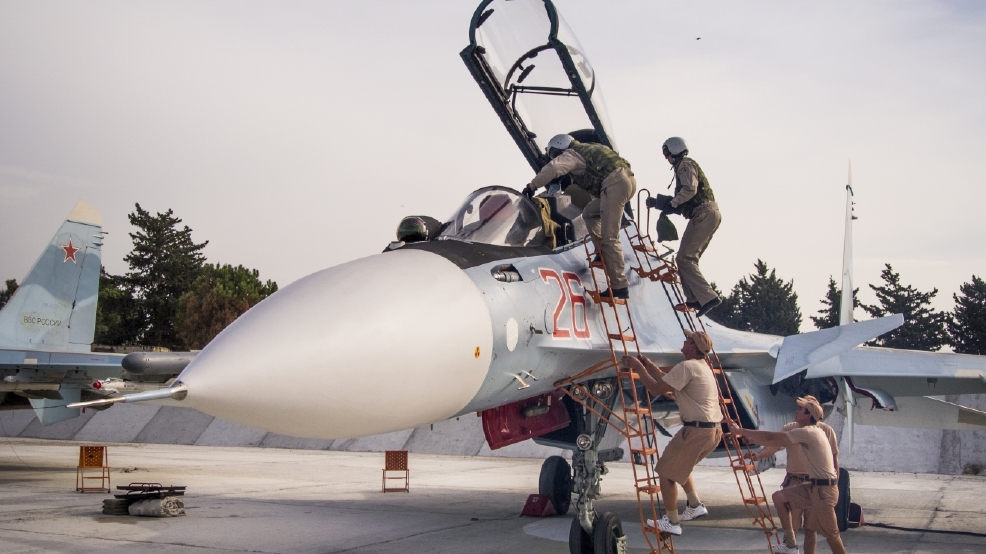
Russia's drawdown and the prospects for peace in Syria


http://wjla.com/news/capital-insider/russias-drawdown-and-the-prospects-for-peace-in-syria


FILE - In this file photo taken on
Thursday, Oct. 22, 2015, Russian air force pilots assisted by ground
crew climb into their fighter jet at Hemeimeem airbase, Syria. (AP
Photo/Vladimir Isachenkov, File)


 Russia's defense ministry says its first group of warplanes in Syriaare headed home -- one day after a surprise announcement by Russian President Vladimir Putin that he will pull back most Russian forces aspeace talks resume in Geneva.

Col. Douglas Macgregor (ret.), executive vice president of the Burke-Macgregor Group, discussed the issue with Capital Insider.

PDF Presentation

Presentation at the Air Force Academy Symposium on Character and Leadership (25 and 26 FEB 2016).


Tuesday, March 1, 2016

Does the Army need airborne?

ARMY TIMES

THE ARMY IS FULLY INVESTED, BUT SOME SAY THE TACTIC IS IMPRACTICAL, COSTLY AND DISCONNECTED FROM MODERN WAR.


By Kyle Jahner

ZARAGOZA, Spain — About 1,200 soldiers from 13 countries looked up toward the thin white clouds stretching across the sky. Having just participated in a brief NATO battle demo, they awaited the November event’s finale.

First Lt. Tim Pena would later say it was “a beautiful day to jump.” But he hadn’t quite arrived just yet.

Right on time, three C-17s cleared the hills to the north, about 1,000 feet above the ground. They flew over the fictional village of “Casas Altas” — an assembly of concrete buildings where the brief staged battle had occurred. A few seconds later, soldiers who nine hours earlier had taken off from Fort Bragg, North Carolina, began to pour from each of the two rearward doors, in standard one-second intervals. Over 500 U.S. paratroopers from 2nd Brigade, 82nd Airborne Division floated to the rocky ground below — it was a beautiful sight.

The jump capped an event, designed largely for the international press, to wrap up NATO’s broader, 36,000-troop, 30-plus-country exercise known as Trident Juncture. NATO described the demonstration as a message to Russia, though Russia declined an invite.

Nevertheless, NATO and U.S. leaders were pleased. The airborne jump may have been the most visually stunning and logistically impressive element of Trident Juncture: hundreds of soldiers in the U.S. travel across the ocean and reach foreign land — on time, without an airstrip, and armed with M4s.

“It’s a great opportunity for us to show what we can do on the Global Response Force,” said Col. Joseph Ryan, the 2nd Brigade commander who jumped along with his soldiers.

The GRF, generally a rotating brigade in the 82nd Airborne Division, is the nation’s quick reaction force designed to rapidly deploy in an emergency. As the Spain exercise demonstrated, Army regards large-scale combat jumps as a crucial capability of the GRF.

But some consider this tactic to be impractical, disconnected from modern war and an unnecessary expense, if not a virtual suicide mission in a real war. Mass combat jumps have been rare since their introduction in World War II, and rarer still in the last 20 years.

“(The) current composition of the United States airborne forces appears more a product of the airborne community’s lobbying efforts in favor of their own size and autonomy than cold calculations about national interests or military requirements,” writes military scholar Marc DeVore in his 2015 Army study “When Failure Thrives.”

DeVore’s study, the first product of the new Army Press, sent shockwaves through the airborne community. In 90 or so pages, DeVore argues that airborne still exists today not because of successful operations, but rather institutionalization and military culture. Even from the start airborne operations produced inconsistent results, and he said in recent decades technology advances have all but removed them from the modern battlefield, both American conflicts and beyond.

"We’ve gone 38 years with it being tough to say any given airborne operation was necessary to accomplish the overall objective of a given operation," DeVore told Army Times.

DeVore is not alone. Retired Col. Doug Macgregor has emerged as a vocal Army critic since retiring in 2004. The former 1st Squadron, 4th Cavalry commander holds a PhD in international relations and calls large-scale airborne operations an “anachronism, a thing of the past” and compared it with horse cavalry use in World War II.

Top Pentagon leaders don’t buy it. They acknowledge a major airborne combat operation is a low-probability option, but say a sizable airborne assault remains a vital capability and deterrent.

“The whole new Army operating concept is we’re back to our expeditionary concept ... the beauty of airborne forces is they were always designed to be expeditionary,” said Lt. Gen. Joe Anderson, the Army's deputy chief of staff for operations and a former XVIII Airborne Corps commander. “Typically, an enemy is not going to want to give you free access to a runway, they’re going to damage it. So how else are you going to get in there and get that stuff capable if you don’t have some light expeditionary package that is able to get in there, doesn’t need a lot of supplies?”

“It’s not an Army requirement … It’s a national security requirement,” Lt. Gen. Stephen Townsend, commander of XVIII Airborne Corps, said of robust and rapid forced-entry capacity. “This is the Army’s highest levels saying this capability is something the country needs.”

Many of the Army’s top leaders have earned their jump wings:  Chief of Staff Gen. Mark Milley, Vice Chief Gen. Daniel Allyn, U.S. Special Operations Command chief Gen. Joseph Votel and acting Army secretary Patrick Murphy. Nine of the Army’s 13 four-star generals have led or served in the 82nd or XVIII Airborne Corps.

Airborne also offers training, morale, retention and recruitment perks, according to leaders. Many airborne soldiers absolutely love what they do, despite — or sometimes because of — its inherent risks.

As many generals have noted, you can’t plan for every war and the U.S. has consistently failed to predict where the next war would be fought, or what specific skills would emerge as indispensable. No one suggests jumping out of planes in general to be obsolete; Special Forces and the 75th Ranger Regiment frequently jump into enemy territory.

But does the Army need four-plus brigades — from combat troops to cooks to public affairs officers — training for low-altitude, low-speed static line jumps with ever-tightening budget restraints? (Anderson said airborne brigades costs about 10 percent more in maintenance than standard light infantry, but still roughly a third as much as an armored unit.) And given a paucity of use that spans wars and decades, what is that tactic’s true place in a modern battlefield?

Low probability...but high consequence?

In mid-August, the Army celebrated 75 years of airborne. It was on Aug. 16, 1940, when the 29th Infantry Regiment conducted its first jump at Fort Benning, Georgia. Since that day, the mission task remains simple: get soldiers and equipment safely from a speeding plane to the ground.

Over the last 15 years, the members of the 82nd have seen more than their fair share of combat in Iraq and Afghanistan — but the vast majority have never sniffed a combat jump. In fact, few large jumps into hostile territory have launched since World War II.

The Army planned to downsize the airborne 4th Brigade Combat Team, 25th Infantry Division in Alaska into a battalion task force by 2017. Milley told Congress in February, however, he wants to push back that move at least a year. If made, that cut would bring five airborne brigades down to 4 and 1/3 (three in the 82nd Airborne Division plus the 173rd Airborne Brigade in Europe).

While leaders defend limiting airborne cuts to its share of Army-wide force reduction, others suggest slashing further.

MacGregor does not see significant tactical need for a mass combat jump of infantry forces. He says even basic air defense renders an airborne attack suicidal.

_______

CORRECTION:  Colonel Macgregor was misquoted in the article as saying "heavy" armor.  He actually advocates medium-weight armor that is air-deployable and well-armored against the threat with active protection systems...etc.